All posts by anzplantsoc

Wakehurst Place

APS Southern Meeting At Wakehurst Place

Wakehurst Place, the Sussex outpost of Kew gardens, is always interesting, and even better with  plantaholic company. We will meet at 11am on Saturday 12 July 2014 at the main entrance, by the counters where entry tickets are sold.

The southern hemisphere garden at Wakehurst has undergone substantial enlargement in recent years and  the plantings are being realigned  to show their individual geographic origins of New Zealand, Tasmania, Australia, South America and South Africa. According to the website these include a rare daisy bush, Olearia lacunosa,  mature eucalypts, hebes and waratah (Telopea truncata) as well as nerines and red-hot pokers. There used to be a huge needle bush (Hakea species)  in one of the beds; hopefully it hasn’t been removed in the re-organisation. At the time of our last visit (2011) the garden also contained Allocasuarina littoralis, Correa lawrenciana and Pelargonium australe and with any luck Blandfordia punicea (Tasmanian christmas bells) will be flowering in the monocot garden. In addition, Wakehurst holds the national collection of southern beeches, Nothofagus, which contains fifteen of the nineteen species from the South America and the antipodes.

Please bring plants to swap; we can do so in the car park.

Palm House Royal Botanic Gardens Edinburgh

2014 AGM at Royal Botanic Gardens Edinburgh

The 2014 National Meeting will be held at the Royal Botanic Gardens Edinburgh. Edinburgh has plenty to delight the Australasian plant enthusiast, with many hardier species outside in the rock garden area and more tender ones in and around the glasshouses. There are also many species to see from southern Africa and South America and the Garden holds the national collection of Vireya rhododendrons of which there are a few Australian representatives. If you have a specific interest it is worth checking out the catalogue of  living collections beforehand (go to the website and click on ‘databases’).

All members are most welcome to attend. Please don’t feel that you have to be very knowledgeable about Australasian plants: you don’t! The whole day, including the annual general meeting will be quite informal, with the focus on discussion and learning, both from the visit and from each other.

We will meet at 11am in the reception area in the John Hope Gateway,  just inside the West Gate entrance in Arboretum Place. There are interesting exhibits, and a restaurant, where you can pass the time should you arrive early. (The Garden opens at 10 am and there is no admission charge.)

The day will begin with the business bit, a short annual general meeting lasting until about lunchtime. With two restaurants and a cafe selling snacks there are plenty of places to eat if you don’t want to bring a packed lunch. This will be followed by a tour of the Garden, including the glasshouses. The APS will pay the glasshouse entry charge for members. Closing time is 6 pm.

Should you want to bring plants to swap there will be an opportunity to do this but for bio-security reasons members’ plants can’t be taken into the Garden. Within the Garden itself there is an outdoor plant sales centre,  profits from which are used directly to support RBGE’s work.

The RBGE is situated just off the A902, one mile north of the city centre (EH3 5LR for satnav users). According to the website there is extensive parking (free at weekends and evenings) around the perimeter of the Garden and on adjacent side streets. However spaces may well fill up quickly after opening time. The nearest rail station is Edinburgh Waverley, which is 1½ miles away and is connected to the Garden by Lothian Buses service 8 which stops at the East Gate in Inverleith Row. The  East Gate  is also very close to the National Cycle Network Route 75, a dedicated traffic-free cycle path. A limited amount of bicycle parking is available at both the East and West Gates but bicycles are not allowed in the gardens.

If you intend to come please advise Judy Clark (editor@ anzplantsoc.org.uk)

Join Us

Join Us

By joining us you will not only gain access to the vast knowledge of our members but also a fantastic seed list, bi-annual journal and great days out visiting interesting collections of Australasian plants where we also hold plant swaps.

Details on how to join us can be found here.

Lullingstone

Where To Go

Ever wondered where to go to see collections of Australian and New Zealand plants?

Our members have tld us about the gardens listed below – in Great Britain (England, Scotland and Wales), Ireland, France, Italy, Germany and Spain – just click on the garden name to see their website.

If you know of a garden growing Australasian plants in the northern hemisphere that’s not listed here please let us know so we can add it. Thanks.

England

Abbotsbury Subtropical Gardens, Dorset https://www.abbotsburygardens.co.uk/

Birmingham Botanical Gardens https://birminghambotanicalgardens.org.uk/

Cambridge University Botanic Garden https://www.botanic.cam.ac.uk/

Fox Rosehill Gardens, Cornwall https://www.falmouth.co.uk/see-and-do/parks/fox-rosehill-gardens/

Joseph Banks Garden, Lincolnshire https://www.joseph-banks.org.uk/

Lullingstone Castle World Garden, Kent https://www.lullingstonecastle.co.uk/

Markshall Arboretum and Gardens https://www.markshall.org.uk/things-to-see-and-do/arboretum/

Marwood Hill Gardens, Devon https://www.nationaltrust.org.uk/visit/devon/overbecks-garden

Ness Botanic Gardens, Cheshire https://www.liverpool.ac.uk/ness-gardens/

Nymans, West Sussex https://www.nationaltrust.org.uk/visit/sussex/nymans

Overbeck’s Garden, Devon https://www.nationaltrust.org.uk/visit/devon/overbecks-garden

RHS Garden Hyde Hall, Essex https://www.rhs.org.uk/gardens/hyde-hall

RHS Garden Rosemoor, Devon https://www.rhs.org.uk/gardens/rosemoor

RHS Garden Wisley, Surrey https://www.rhs.org.uk/gardens/wisley

Royal Botanic Gardens Kew https://www.kew.org/kew-gardens

Sheffield Botanical Gardens https://www.sbg.org.uk/

The Savill Garden, Surrey https://www.windsorgreatpark.co.uk/explore/the-gardens/the-savill-garden/

Tregrehen Garden Cornwall https://www.tregrehangarden.uk/

Ventnor Botanic Garden, Isle of Wight https://www.botanic.co.uk/

Wakehurst Place, West Sussex https://www.kew.org/wakehurst

Wales

National Botanic Garden of Wales, Carmarthenshire, https://botanicgarden.wales/

Plas Newydd, Anglesea https://www.nationaltrust.org.uk/visit/wales/plas-newydd-house-and-garden

Scotland

Achamore Gardens, Isle of Gigha https://www.visitgigha.co.uk/Achamore-Gardens

Brodick castle Garden, Isle of Arran https://www.nts.org.uk/visit/places/brodick-castle

Glasgow Botanic Gardens https://www.glasgow.gov.uk/botanicgardens

Inverewe, Wester Ross https://www.nts.org.uk/visit/places/inverewe

Logan Botanic Garden, Wigtownshire https://www.rbge.org.uk/visit/logan-botanic-garden/

Royal Botanic Garden Edinburgh https://www.rbge.org.uk/visit/royal-botanic-garden-edinburgh/

The Linn Garden, Argyll and Bute https://www.thelinn.co.uk/

University of Dundee Botanic Garden  https://www.dundee.ac.uk/botanic

Northern Ireland

Mount Stewart Garden, County Down

Rowallane Garden, County Down

Republic of Ireland

The National Botanic Gardens of Ireland, Dublin

France

Jardin botanique de la Villa Thuret, Cap d’Antibes

Jardin des Plantes, Paris (New Caledonian plants)

Parc Gonzalez, Bormes-les-Mimosas, French Riviera

Germany

Pillnitz Castle, Dresden

Italy

Isola Madre, Lake Maggiore

Villa Taranto Botanic Gardens, Lake Maggiore

Spain

Arboreto Del Villa, Huelva, Andalucia

Anigozanthos Flavidus

What’s On?

To find out What’s On in 2026, see the events below. If you would like to volunteer to help with any of our events or have any other queries please email:  meetings@anzplantsoc.org.uk.

2026

APS Annual General Meeting

The next AGM of the Australasian Plant Society will take place in the new nursery at the Sir Harold Hillier Gardens, Hampshire on Saturday 11th April 2026, at 10.30am.

We are delighted to be welcomed back to the garden by botanist Barry Clark, who will be kindly showing us some of his own personal collection of Australasian plants held at the new garden glasshouse complex, which is not open to the general public. He will follow this with a tour of the gardens highlighting some of the many Australasian plants grown there.

Further information will follow. In the meantime please
contact Gary Firth at chairman@anzplantsoc.org.uk with any queries.

Plant Fairs for 2026

Come and see us at these plant fairs this year. We’ll have a lovely range of Australasian plants grown by our members and we love talking about Australasian plants!

19 April (Sunday) at the Plant Fair Road Show at Arundel Castle in West Sussex

3 May (Sunday) at the Surrey Plant Heritage plant fair at Denbies Wine Estate near Dorking, Surrey

10 May (Sunday) at Plant Fair Road Show at Borde Hill in West Sussex

5 July (Sunday) at Plant Fair Road Show at Parham Castle in West Sussex

16 August (Sunday) at the Surrey Plant Heritage plant fair at Denbies Wine Estate near Dorking, Surrey

20 September (Sunday) at Plant Fair Road Show at Borde Hill in West Sussex

27 September (Sunday) at Plant Fair Road Show at Mount Ephraim in Kent

If you wish to support us as a member and receive our twice yearly publication Pentachondra, plus the chance to access our special range of seeds we’d be delighted – just click here.

—————————————————–

To see our diary of previous events please click here:  Australasian Plant Society – history of events 2024 back to 2013

—————————————————

Rhododendron viriosum

Australian Rhododendrons

There are over 900 rhododendron species. The genus is split into several subgenera, one of which is called Vireya. One of Vireya’s characteristics is the presence of scales on the leaves, stems, flowers and fruits. The purpose of these scales is not known but a possible explanation is that they help to protect the plant from the strong solar radiation on the tropical mountains where they are found.

The first mention of an Australian rhododendron  was when Baron von Mueller collected and named Rhododendron lochae  on the Bellenden Ker range, inland from Cairns in Queensland.  Nowadays the specific name, which commemorates Lady Loch, then wife of the Governor of Victoria and a patron of horticulture, is spelt lochiae. The first account of  R. lochiae being cultivated was in the Gardeners’ Chronicle in 1939, where it was reported as growing at Kew. In 1953 Rhododendron lochiae  appeared in the catalogue of Basil Hodgkins, at his nursery in Essendon, Victoria. It quickly became popular and was used as a parent of many hybrids.

In the early 1990s it became apparent that two different plants were being grown and sold as R. lochiae  and the botanist Lyn Craven discovered that the Hodgkin plant was new to science.  To change its name would have caused much confusion in horticulture all round the world, so Craven created a new type species and called the von Mueller plant R. notiale (meaning from the south). Unfortunately this action did not meet with the approval of international botanists so it was renamed R. viriosum, while the von Mueller plant remained as R. lochiae.

Identification

When not in flower the two plants are indistinguishable but in bloom they are easily separated:

R. lochiae has a curved floral tube, with the stamens on one side. This indicates that it is pollinated by birds.

R. viriosum has a straight floral tube, with the stamens arranged in a circle (see photo page 20).

It is possible that further species remain to be discovered in the mountains of North Queensland.

Cultivation

In the wild these plants grow both as epiphytes and on the ground, on steep slopes, and in rich soil with much organic matter. They are subject to frequent heavy downpours of rain and the cool mountains on which they are found are often misty. Although growing in acid conditions, they have a high requirement for calcium.

I have found that they can be grown in leafmould and in a mixture of equal parts of coarse and fine bark. Calcium was added as baking powder (it contains acid calcium phosphate). Temperature is also important. Temperatures below 5°C result in dark spots on the leaves, which also lose their gloss. A winter minimum of 10°C is recommended.  The compost must never be allowed to dry out, yet must be very well drained.

Seedlings bloom in their third year and for me that has been in August. However at the Tatton Park Flower Show R. viriosum has been shown in bloom in late July.

Author : Jeff  Irons

Published: Issue 47 (December 2011)

Acacia dealbata

Acacia dealbata

Seeing the picture of acacias on the Algarve on the cover of the May 2009 Pentachondra prompted me to write this article about Acacia dealbata.

A. dealbata is confined to Tasmania, Victoria, New South Wales and the Australian Capital Territory where it has the common name of Silver Wattle. In the United Kingdom it is called Mimosa or Florists’ Mimosa and  it used to be sold in posies or bunches by florists and even from street barrows in London. Flowering branches came into England from southern France but it is many years since I saw Mimosa on sale. Whilst much admired as a cut flower in Europe, in Australia it is considered bad luck to bring cut branches in flower into the house.

In southern parts of Australia it can make a shrub but more often it is a tree, especially in Tasmania where it can reach or even exceed 100 feet (30 metres). Most species of Australian acacia have their leaves replaced by phyllodes which are hard and spiny (see Jeff Irons’ article on the botany of Acacia in Pentachondra December 2008, page 8). Acacia dealbata has true bi-pinnate leaves which are silvery-grey, hence the common name. New stems and young leaves have a silvery pubescence which intensifies the leaf colouring. There are forms in which the leaves are glaucous rather than silvery, becoming almost blue in some selections. It was the blue leaved forms that were favoured by florists. In my experience, these forms are less hardy than the silvery grey ones.

Flowering occurs in winter or early spring. The yellow spheroidal heads of tiny fragrant flowers form large panicles. In the open this species tends to be tender and has not been reliably hardy in Britain except perhaps for the south west. But after 20 years of mild winters it might well be that it has become more widely established and plants have grown to flowering during that period. Flowering is variable and is dependent on summer warmth in the year before flowering.

My experience of it in southern England was in the earlier decade of the 1980s when cold winters with snow were frequent. I raised saplings from a range of wild collected seed from many sources. These were planted at the foot of a high south facing wall with most being killed off during the first winter. If they survived this stems were thicker and  roots had penetrated deeper and as a result these saplings were more likely to survive the next winter. My best result was with saplings raised from high altitude Tasmanian seed. One of these survived for four winters and  reached  a height of 15 feet (nearly 5 metres) only to be killed in the next.

Wattles are easy to raise from seed. Pour boiling water over the seed and allow it to remain in the cooled water for 24 hours before sowing. In my experience A. dealbata requires an acid soil and yet one can read in books that it will tolerate some alkalinity. Most usually, even in the milder winters, shrubs/trees will be grown against a south facing wall and this needs to be of considerable height.

A memorable experience, from when I was flying over Tasmania in winter on a journey from Melbourne to Hobart, was to see through the portholes mountain tops which were golden with the flowers of Silver Wattle.

Author: Brian Halliwell

Published: Issue 43 (December 2009)

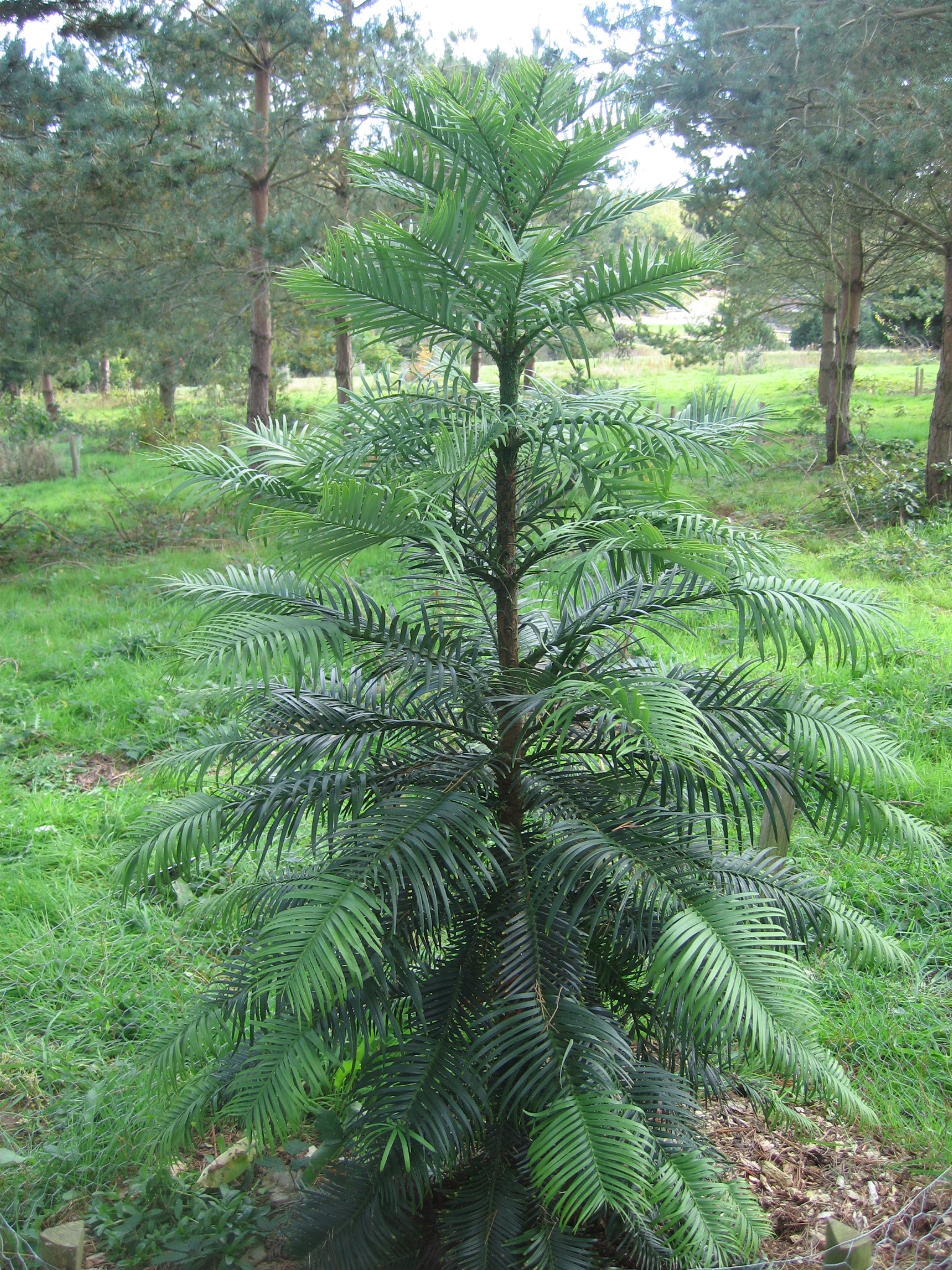
Phyllocladus aspleniifolius

Celery-Top Pine

Early travellers along Tasmania’s rivers often saw what looked like the top of a bunch of celery sticking up above the general rainforest canopy. They called the tree that bears it Celery-top Pine. Botanists took a different view and thinking that the foliage resembled that of a Spleenwort, gave it the specific name aspleniifolius. They put it in the genus Phyllocladus.

So the botanical name of Celery-top Pine is Phyllocladus aspleniifolius.  The Greek word for leaf is phyllon and that for branch is cladon. So the name, daunting at first sight, actually tells us that the flattened branchlets (cladodes), which contain chlorophyll,  have taken over the function of the leaves and that the cladodes themselves are shaped like the frond of a Spleenwort (see photo page 9). The true leaves are minute deciduous scales, seen along the edges of the cladodes.

Plants can either bear flowers of one sex only, or can have separate male and female flowers. Often in clusters of 3 or 4, the flowers are borne on the cladode edges and the fruit, like that of a yew, is a small nutlet surrounded by a fleshy aril. Scale bracts at the base of the fruit turn pink or red and swell so that they partly enclose the aril, acting as bird attractants.

Phyllocladus used to be found over  a large part of S.E. Asia but today there are only four species, one in Australia and New Zealand and three others in Malesia. They are not pines (Australians give that name to all conifers) but are actually in the southern family Podocarpaceae.

Celery-top Pine is a tree with a straight bole and no buttresses. Although it can be up to 30 metres high, specimens of less than 20 metres are quite common.  Needing moist acid soil, in the wild it grows in conditions with cold winters and cool or humid summers with an annual rainfall of 1000-3000 millimetres. Seedlings have long narrow true leaves and quite quickly the new foliage is cladodes, not leaves. Like legumes and casuarinas the tree has a mycorrhizal association which enables it to utilize soil nitrogen, so seedlings should be put into a compost containing unsterilized soil and there are obvious implications for cuttings.

Nowadays it is confined to Tasmania, with a dwarfed subspecies alpina in New Zealand. This latter plant has a green ‘leaved’ and a glaucous ‘leaved’ form. Both can be found in British gardens. As pot specimens they enable gardeners with small gardens or alkaline soil to grow this delightful, handsome  and desirable tree.

Author : Jeff Irons

Published: Issue 43 (December 2009)

Sturt's Desert Pea

Growing Sturt’s Desert Pea

Sturt’s Desert Pea (Swainsona formosa) is one of the iconic plant species of inland Australia, and is the floral emblem of South Australia.  In the wild it can produce massed displays of extraordinary scarlet flowers, usually having a glossy black central boss.

The photograph on the front cover, taken in August 2006, shows one such display in the Cape Range National Park in Western Australia. It is worth noting that many populations in that park lack the glossy black boss on the flowers.

It is reputed to be fairly easy to cultivate in hot climates.  I  guess it has been cultivated in Britain occasionally, though I am not aware of any reports of this.  It seemed to be an interesting challenge….

I bought a small packet of seed in Australia in 2006, and decided to give it a go this spring.  The seed germinated well and rapidly using the bog method on an indoor windowsill, without any pre-treatment of the seed, following sowing on 5th May.  The young seedlings transplanted well into a peat-based compost containing 30% perlite, and grew on in the greenhouse. Then slugs discovered them (even in the greenhouse!).  I transplanted the surviving plants into 2 litre pots (both clay and plastic) containing a similar, well-drained, soil-free compost.  The plants that had survived the slugs grew well initially, but many succumbed to root rots in the dank conditions in July and August.  Two plants initiated flower buds during August, and one of these flowered in early September. This plant made a spectacular display on our kitchen windowsill before it too succumbed to a root rot. These flowers too had paler bosses than normally seen in the wild, but the red colouration was superb.

With hindsight, and having read more on the cultivation of this species, I may have achieved better results had I used a free-draining inorganic compost at transplanting.  And I am sure I would have seen better growth had there been more sun this summer!  Nevertheless, my experience does show that Sturt’s Pea can be grown to flowering fairly easily, and I’ll try again.

Author: John Purse

Published: Issue 41 (December 2008)